The PractikAI AI Adoption System: From AI Curiosity to AI Capability

Ask ten different supply chain executives where their organization stands with AI, and you will likely get ten different answers, because "AI adoption" means something different depending on who is talking. To one leader, it means a chatbot pilot in customer service. To another, it means a data governance policy that has been sitting in draft for six months. To another, it means an agentic tool a vendor is trying to sell them, with no clear sense of whether the organization is even ready to use it.
The truth is that AI adoption is not a single decision or a single project. It is a system, a sequence of deliberate stages that take an organization from curiosity about AI to real, sustained capability. Skip a stage, and the gap shows up later, usually at the worst possible time: a pilot that cannot scale, a tool no one trusts, a policy written after a problem has already occurred.
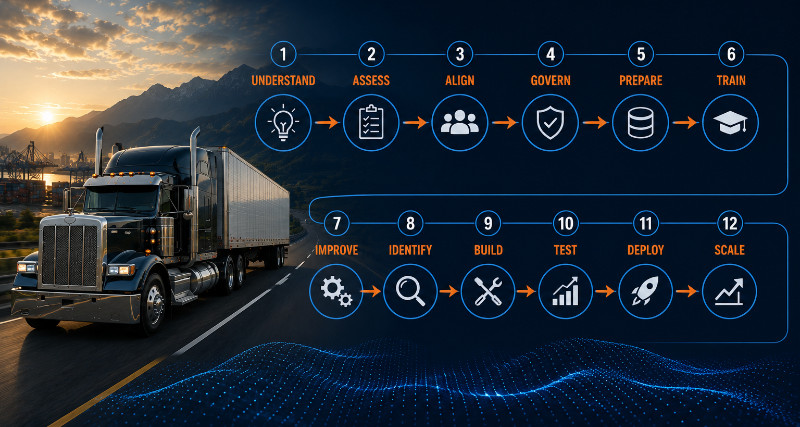
That is why we built the PractikAI AI Adoption System, a twelve-stage framework designed specifically for supply chain and logistics organizations moving from AI curiosity to AI capability.
Why a Framework, and Why This One
Most conversations about AI adoption compress a complex, cross-functional transformation into a handful of vague steps ("assess, pilot, scale") and skip over the parts of the work that actually determine whether an initiative survives contact with a real operation. Data readiness gets treated as an afterthought. Use-case identification gets skipped in favor of whatever the loudest vendor is pitching. Testing and deployment get collapsed into a single step, as if proving value and operationalizing it were the same thing.
We built the PractikAI AI Adoption System around a different premise: every one of these stages deserves explicit attention, because organizations that skip them pay for it later. The result is twelve stages, each answering a distinct question an organization must be able to answer before moving to the next.
The Twelve Stages
1. Understand: What is AI, what can it do, and what does it mean for a supply chain organization?
Before an organization can make good decisions about AI, its leaders and employees need a shared, accurate understanding of what AI actually is (the difference between generative AI, agentic AI, and traditional automation) and what it realistically means for their specific operation. Adoption efforts that skip this stage tend to run on hype and misconception rather than informed judgment.
2. Assess: Is the organization actually ready?
Readiness is not a feeling; it is a set of measurable conditions across people, process, data, technology, and governance. This stage is an honest audit, not of ambition, but of actual capacity to execute.
3. Align: Are leadership and employees aligned around the opportunity?
AI initiatives fail as often from misalignment as from bad technology. Leadership needs a shared vision. Employees need to understand what AI means for their roles, not fear it. This stage builds the internal consensus that everything downstream depends on.
4. Govern: How should AI be used responsibly and safely?
Responsible AI governance is not a compliance checkbox added at the end, it is infrastructure that has to exist before deployment, not after an incident. This stage establishes the policies, guardrails, and accountability structures (including, for many organizations, an internal AI Council) that make safe use possible at scale.
5. Prepare: Are the data, knowledge, technology, and processes ready?
This is the stage most adoption efforts underestimate. AI is only as good as the data and knowledge it draws on and the technology and processes it operates within. Preparation work here (cleaning data, documenting institutional knowledge, evaluating existing systems) often turns out to be the highest-value work an organization does, independent of which AI tools eventually get used.
6. Train: Can employees and leaders use AI effectively?
Capability lives in people, not just in tools. This stage builds the practical skills (prompting, evaluating outputs, knowing when to trust AI and when not to) that determine whether an organization actually gets value from what it adopts.
7. Improve: Which business processes should be improved before AI is applied?
Applying AI to a broken process automates the breakage. This stage identifies where process improvement needs to happen first, so that AI is amplifying something that works rather than accelerating something that does not.
8. Identify: Where are the highest-value AI opportunities?
With readiness, alignment, governance, data, skills, and process improvement in place, the organization is finally positioned to answer the right question: not "where can we use AI," but where AI can create the most meaningful business value. This stage is deliberate opportunity identification, not a scramble to find a use case.
9. Build: Should the organization buy, build, or integrate a solution?
Once a high-value opportunity is identified, the organization has to make a clear-eyed decision about the right path to a solution (an existing product, a custom build, or integration into current systems) based on the specific problem, not on what is trending.
10. Test: Can the solution demonstrate measurable value?
Before broad deployment, a solution has to prove itself against real criteria: cost, accuracy, reliability, adoption, and impact. This stage treats testing as a rigorous checkpoint, not a formality on the way to a foregone conclusion.
11. Deploy: Can the solution be implemented into the real workflow?
A solution that works in a controlled test and a solution that works inside the daily reality of an operating business are not automatically the same thing. This stage is about implementation that survives contact with real workflows, real people, and real edge cases.
12. Scale: How does the organization become continuously AI-enabled?
Adoption does not end with one successful deployment. This final stage is about building the muscle (the governance, the skills, the process, the culture) to keep identifying, testing, and deploying value continuously, rather than treating AI as a project with an end date.
A System, Not a Sequence to Rush
It is worth being clear about what this framework is not. It is not a race to stage twelve. Some organizations will spend the most time and get the most value in stages 2 through 5 (assessment, alignment, governance, and preparation) long before they touch a specific tool. Others, further along, may cycle back through Identify, Build, and Test repeatedly as they take on new opportunities. The System is designed to be used both linearly, for organizations just beginning, and cyclically, for organizations already building ongoing AI capability.
What matters is that no stage gets skipped just because it is less exciting than the ones that involve visible technology. The unglamorous stages (Prepare, Govern, Test) are disproportionately where adoption efforts succeed or quietly fail.
From Curiosity to Capability
Every organization starts somewhere on this system, usually with curiosity: a leadership team that knows AI matters but is not sure what to do about it. The PractikAI AI Adoption System exists to turn that curiosity into capability, deliberately, in the right order, with attention paid to the stages that hype-driven approaches tend to skip.
This framework is the foundation for everything we do at PractikAI, and it will anchor the content, tools, and guidance we build going forward. Future articles in this series will go deeper into each of the twelve stages: what they look like in practice, the mistakes we see organizations make, and how to move through them with discipline rather than guesswork.
Start small. Win big.


