The Data and Knowledge Readiness Gap

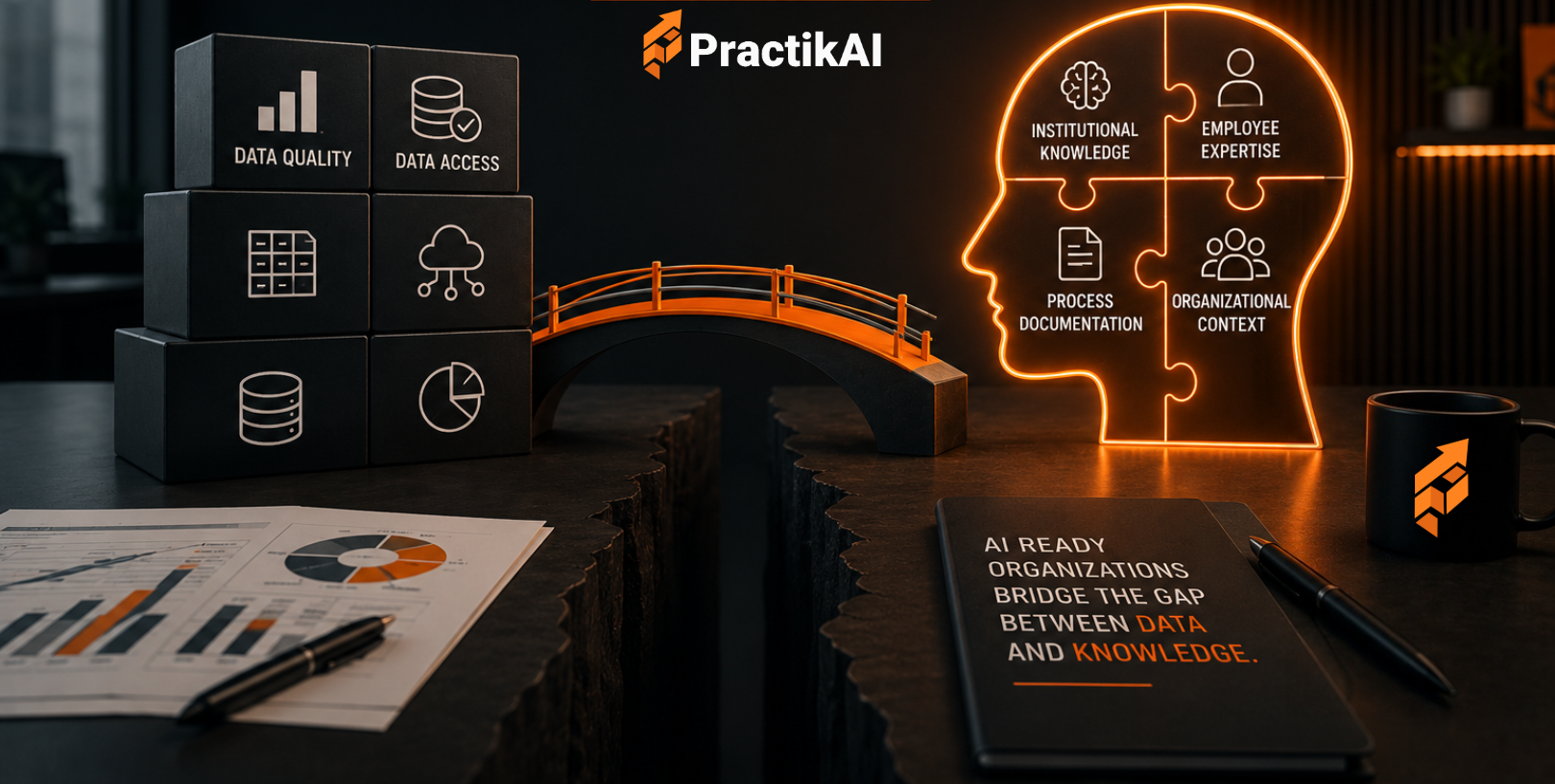
Every conversation about AI readiness eventually arrives at data. Is it clean? Is it centralized? Is it accessible to the systems that need it? These are the right questions, and they are being asked more urgently across the supply chain industry than ever before.
But they are not, on their own, the whole question.
Data readiness has become one of the defining themes in AI adoption conversations, and for good reason. Poor data quality quietly undermines more AI initiatives than any other single factor. Organizations are right to take it seriously. Where we think the conversation needs to go further is here:
AI does not just need more data. It needs usable organizational knowledge.
That distinction, between data and knowledge, is the gap most AI readiness conversations gloss over. It is also where we believe supply chain organizations need to focus next.
Data Is Necessary. It Is Not Sufficient.
Data readiness typically covers two related problems:
Data quality — is the information accurate, consistent, and complete
Data access — can the systems and tools that need this information actually get to it, or is it trapped in silos, legacy platforms, and disconnected spreadsheets.
Both matter enormously. An AI tool built on inconsistent, fragmented, or untrustworthy data will produce outputs that are confidently wrong, which is often more dangerous than a tool that simply does not work. Solving for data quality and access is real, necessary work, and no organization should skip it.
But even an organization with pristine, fully accessible data will still hit a wall, because data alone does not capture how the business actually operates. That gap has a name: knowledge.
The Knowledge That Never Made It Into a System
Every supply chain organization runs on two kinds of knowledge. One kind lives in systems: transaction records, shipment histories, structured fields in a TMS or ERP. The other kind lives in people, and it rarely gets written down anywhere.
This is institutional knowledge: the judgment calls a twenty-year dispatcher makes without thinking twice, the specific carrier who always needs a phone call instead of an email, the customer whose "urgent" actually means urgent and whose "urgent" usually does not. It is employee expertise: the pattern recognition built from years of handling exceptions that never fit neatly into a workflow diagram. It is process documentation that either does not exist, exists but is outdated, or exists but describes how a process is supposed to work rather than how it actually works day to day. And it is organizational context: the reasons behind decisions, the history of why a workaround exists, the unwritten rules that make an operation function.
None of this shows up in a database. All of it shapes how the business actually runs. And when an organization tries to apply AI without accounting for it, the AI ends up operating on an incomplete picture of the business. It’s technically accurate about the data it can see, and blind to the judgment that has always filled in the rest.
Why This Gap Matters More as AI Gets More Capable
This gap has always existed, but it matters more now than it did five years ago, for a specific reason: as AI systems move from simple automation toward agentic tools that take multi-step action with less human oversight, the cost of an incomplete picture goes up. A rules-based system that only sees structured data can be scoped narrowly enough to avoid the gap. An AI agent making judgment calls across exceptions, routing decisions, or customer communications will inevitably run into the scenarios that only institutional knowledge would catch: the exception to the exception, the customer relationship nuance, the reason a "standard" rule does not apply this time.
Some organizations are starting to recognize this. Knowledge capture, turning tacit employee expertise into something searchable and referenceable, is emerging as its own category of AI tooling, and it is a meaningful piece of the puzzle. But knowledge capture on its own is still only part of the answer. Capturing what one experienced employee knows is valuable. It does not, by itself, tell you whether that knowledge connects to your data correctly, whether your processes reflect it, or whether the organization has the governance and structure to keep using it as people and systems change.
PractikAI's View: This Is an Organizational Framework, Not a Point Solution
We believe the real opportunity is not a single tool that captures knowledge, or a single initiative that cleans data. It is a broader framework that treats data and knowledge readiness as one connected discipline, made up of six components that reinforce each other:
Data quality — is the information accurate, consistent, and trustworthy?
Data access — can the right systems and people actually reach it?
Institutional knowledge — has the tacit expertise inside the organization been identified at all?
Employee expertise — is that expertise captured in a usable, current form, not locked in one person's head?
Process documentation — does written process reflect how work actually happens, not an outdated ideal?
Organizational context — is the reasoning behind decisions and exceptions preserved, so that judgment does not have to be rebuilt from scratch every time someone leaves?
Treated separately, these six components become six disconnected initiatives: a data cleanup project here, a documentation effort there, a knowledge base nobody maintains. Treated together, as a single readiness discipline, they give an organization something far more valuable: a foundation an AI system can actually be trusted to operate on, because it reflects both what the business records and what the business knows.
Where This Fits in the Adoption System
In the PractikAI AI Adoption System, this work sits inside the Prepare stage: the point at which an organization gets its data, knowledge, technology, and processes genuinely ready, before it moves toward identifying and building specific AI solutions.
Organizations that treat Prepare as "a data cleanup project" tend to under-invest in the knowledge half of this equation, and they feel that gap later, usually right when an AI tool starts making decisions that used to depend on someone's judgment.
Closing the data and knowledge readiness gap is not a one-time project with a clean finish line. It is ongoing organizational discipline, the kind that pays off well beyond whatever specific AI tool gets adopted next, because it makes the organization's own operational knowledge durable, transferable, and finally visible to the systems trying to support it.
Start small. Win big.
